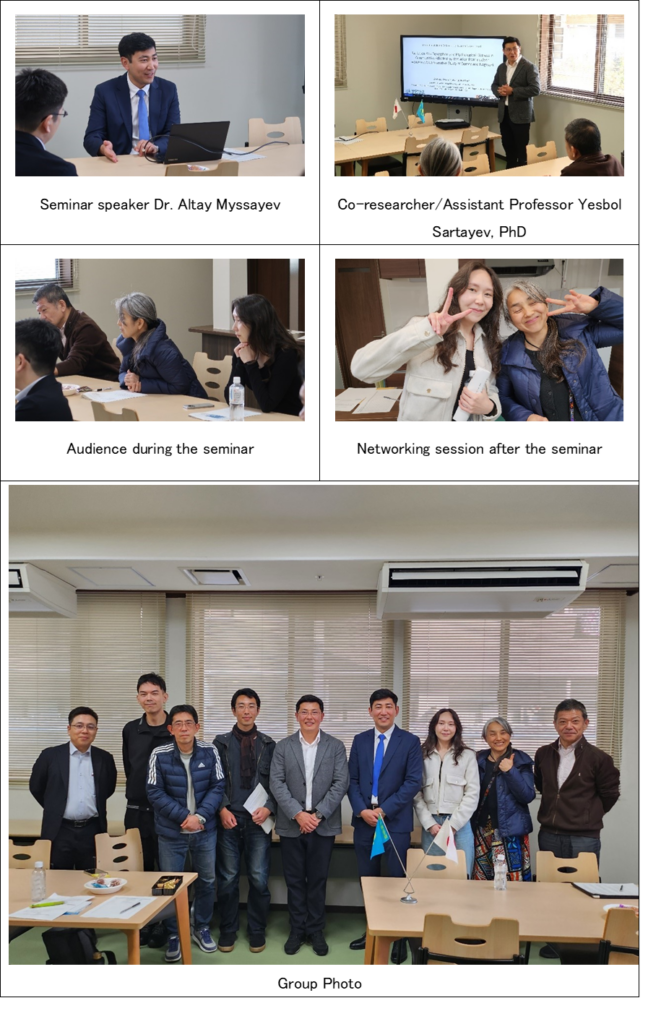
On March 19th, an international seminar titled“Nagasaki and Semey: Radiation Risk Perception in Populations Affected by Atomic Bombing after Several Decades” was held at the Yeh Kuo-Shii Global Friendship Center on Nagasaki University’s Bunkyo Campus. We welcomed Dr. Altay Myssayev, an alumnus who completed his doctorate at the Biomedical Sciences Life Sciences and Radiation Research and is currently a Medical Research Fellow at the Barcelona Institute for Global Health in Spain, as the guest speaker.
During the seminar, Dr. Myssayev presented the latest findings from a comparative study focusing on two regions historically affected by nuclear weapons: Nagasaki, which experienced an atomic bombing in 1945; and Semey, Kazakhstan, where numerous nuclear tests were conducted by the former Soviet Union.
Based on a large-scale survey of 2,394 participants conducted between late 2025 and early 2026, Dr. Myssayev reported on analytical results found by using the Radiation Risk Perception Index (RRPI). The findings revealed that residents in both Nagasaki and Semey continue to hold long-standing concerns about radiation which are shaped by their historical backgrounds. These concerns were particularly pronounced in Semey, where fears regarding genetic and health effects remain strong. The seminar also explained how differences in age groups and information sources influence levels of risk perception, offering participants a valuable opportunity to understand the gap between scientific knowledge and public beliefs.
This event was held in collaboration between NUGAN (Nagasaki University Global Alumni Network) and the Nagasaki University Research Center for Global Risk. The invitation of the speaker was supported by the International Collaborative Research Support Program for Alumni Networks.